
Diesel Engine Cam Belt Replacement Intervals: The Definitive UK Guide
My mate Dave learned the hard way on the M25 anticlockwise near Cobham services. One moment he was cruising at 65 mph in his trusty 2015 diesel estate; the next, a sickening clatter erupted from the engine bay and the rev counter dropped to zero. The RAC patrolman didn’t even need to lift the bonnet fully before delivering the death sentence: “Timing belt’s gone, pal.” Dave had owned the car for seven years and had never once checked the service schedule for the cam belt interval. That £35 service book oversight cost him an entire engine—a £4,500 bill that rendered a perfectly good Euro 6 diesel instantly worthless. We don’t want you to make Dave’s mistake.
Why Diesel Cam Belt Intervals Are So Critical
Modern diesel engines are engineering masterpieces of high-pressure efficiency, but they possess an Achilles’ heel hidden behind their plastic covers. When a cam belt snaps on a motorway, the precision synchronisation between the crankshaft and camshaft disappears in a millisecond. Valves freeze mid-stroke while pistons continue hammering upward, and the resulting collision destroys cylinder heads, bends conrods, and shatters pistons. We see this catastrophic domino effect most often on common-rail turbo diesels where the margin for error is zero.
Interference Engines vs. Non-Interference: The Costly Difference
Almost every diesel engine sold in the United Kingdom over the last two decades is an interference design. That means the valves and pistons occupy the same physical space at different times, separated only by the integrity of your cam belt. When that belt fails, metal meets metal at thousands of revolutions per minute. Non-interference engines—where the valves sit safely outside the piston sweep—are practically extinct in modern diesel engineering because they cannot achieve the compression ratios required for efficiency. If you drive a Ford TDCi, a Vauxhall CDTI, a Volkswagen TDI, or a Peugeot HDi, you are driving an interference engine. A snapped belt does not mean a roadside inconvenience; it means a complete engine replacement.
Why Diesel Compression Kills Ageing Belts
Diesel compression ratios routinely exceed 16:1, compared to roughly 10:1 in a typical petrol engine. That immense cylinder pressure translates directly into violent rotational forces on the camshaft pulley, which yanks at the belt teeth with every injection stroke. A rubber compound that was supple and reinforced when new becomes brittle and micro-cracked after years of heat cycling. The high-pressure fuel pump on a common-rail system—often driven directly by the timing belt on engines like the Renault 1.5 dCi—adds another layer of shock loading. We’ve inspected belts removed just days before their scheduled interval that showed terrifying tooth separation, held together by little more than hope and a plastic cover.
Mileage vs. Age: Which Limit Comes First?
The service book always states a mileage figure and a time figure, followed by that crucial phrase: “whichever comes sooner.” In our experience across thousands of UK diesel services, the calendar is almost always the enemy, not the odometer. We regularly see diesel cars with barely 40,000 miles on the clock that are dangerously overdue because the owner assumed low mileage meant low risk. A cam belt sitting stationary for weeks in a damp driveway degrades just as surely as one spinning daily up the M1.
The 5-Year Rule: Rubber Deterioration in the UK Climate
Our damp, temperate British climate is uniquely hostile to rubber compounds. A timing belt lives in an environment that cycles from freezing winter mornings to hot summer traffic jams, all while absorbing moisture from the air every time the engine cools. That moisture attacks the cord reinforcement inside the belt, causing oxidation and delamination. Most manufacturers specify a five or six-year replacement interval for diesel cam belts sold in the UK market, not because the belt will certainly snap at five years and one day, but because the statistical probability of failure climbs sharply after that point. We treat the five-year mark as a hard deadline, not a suggestion.
Low-Mileage Danger: Why a Garage Queen Still Needs a Change
We encounter a dangerous myth among owners of second cars, campervans, and low-mileage commuters: the belief that a diesel engine sitting unused is somehow preserving its timing belt. The opposite is true. Belts that sit stationary for extended periods develop a “memory” of their curved shape around the pulleys, leading to cracking at the bend points when they finally rotate again. The rubber compound also stiffens without the regular flexing that keeps plasticisers distributed through the material. If your diesel motorhome covers just 2,000 miles annually but its belt is seven years old, you are driving a ticking time bomb to the Cornish coast every summer.
Manufacturer-Specific Diesel Belt Intervals
The variation between manufacturers is staggering, and we’ve seen it catch out even experienced mechanics who assume a standard interval applies across the board. A 2018 Ford Kuga diesel and a 2018 Vauxhall Insignia diesel have completely different cam belt requirements, and guessing wrong destroys engines. We recommend treating your specific vehicle’s interval as a critical piece of data, not a generic guideline.
Ford EcoBlue vs. PSA HDi: The 10-Year Claim
Ford’s 2.0 EcoBlue diesel engine arrived with a headline-grabbing official timing belt interval of 10 years or 144,000 miles. That figure applies to the belt-in-oil “wet belt” design that we view with considerable scepticism. Meanwhile, the PSA Group’s 1.5 BlueHDi engine—fitted to countless Peugeot, Citroën, and Vauxhall models—has generated a wave of premature wet belt degradation issues. We’ve seen these belts shedding rubber particles into the oil, which then clog the oil pump pickup strainer and starve the engine of lubrication. The official interval may say one thing, but the reality of degraded belt material circulating through your oil system tells a different story entirely. Many independent specialists now recommend halving the official interval on these engines.
Volkswagen Group TDI: Pump-Prose vs. Belt Life
Volkswagen Group’s EA288 2.0 TDI engine, found in everything from the Golf to the Seat Leon and Skoda Octavia, generally requires a timing belt inspection at five years with replacement intervals varying by model year. The high-pressure fuel pump on these engines places significant additional load on the belt, and we’ve learned to treat VAG’s service literature with a degree of caution. A belt that looks fine visually can still fail internally where the cord reinforcement meets the rubber teeth. Our workshop policy on EA288 engines errs on the side of early replacement, typically at the five-year mark regardless of mileage.
BMW N47 and B47: The Chain Recall Legacy
BMW’s N47 diesel engine became infamous for timing chain failures that led to a BBC Watchdog investigation in the UK. The chain was positioned at the rear of the engine, meaning a failure required complete engine removal for access—a repair bill that frequently exceeded the value of older BMW 1 Series, 3 Series, and 5 Series models. The later B47 engine improved the design but did not eliminate the fundamental vulnerability of a rear-mounted chain drive. These engines serve as a powerful reminder that “chain” does not automatically mean “reliable.”
Belt vs. Chain: The Diesel Longevity Myth
British car buyers have absorbed a persistent piece of folklore: timing chains last forever and timing belts are a weakness. We spend a significant portion of our working week dismantling this myth for customers who bought a chain-driven diesel specifically to avoid cam belt replacement costs, only to face even larger bills when the chain system failed. The truth is far more nuanced, and several high-profile chain disasters have reshaped our understanding of diesel engine longevity.
The ‘Wet Belt’ Disaster: Ford and PSA’s Internal Belt Fiasco
The industry’s attempt to merge the supposed benefits of belts and chains created what we consider the worst of both worlds: the wet belt. Ford’s 2.0 EcoBlue and PSA’s 1.5 BlueHDi engines run their timing belts inside the engine, submerged in hot engine oil. The theory was reduced friction and extended life. The reality, documented extensively by UK independent specialists, is that these belts degrade from the inside out, shedding rubber debris that blocks oil pickup pipes and starves bearings. PSA 1.5 BlueHDi wet belt degradation issues leading to clogged oil pump pickups have become a recognised failure pattern. Replacing a wet belt requires extensive engine disassembly and meticulous cleaning of the oil system, often costing more than a conventional dry belt replacement.
When a Chain Drive Costs More Than a Belt Job
A timing chain replacement on a BMW N47 diesel can easily exceed £2,500 at an independent specialist. The chain itself is a fraction of that cost; the labour to access a rear-mounted chain drive is the killer. Compare that to a conventional cam belt replacement on a Volkswagen 2.0 TDI, which typically costs between £450 and £700 including the full kit and water pump. The chain-driven diesel that was supposed to save money ends up costing three to four times more when it eventually fails. Chains stretch, tensioners wear, and guides crack. They require clean, high-quality oil throughout their life, and missed oil changes accelerate wear dramatically.
Full Kit Replacement: Tensioners, Water Pumps, and Pulleys
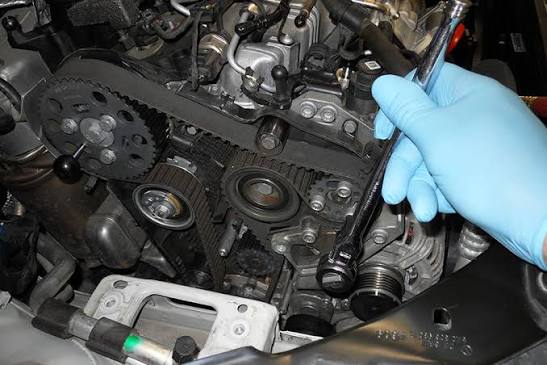
We refuse to replace just a timing belt in isolation, and we urge every diesel owner to adopt the same policy. The belt itself is almost never the first component to fail. A seized tensioner bearing, a wobbly idler pulley, or a water pump with a collapsing bearing will destroy the belt within seconds, causing exactly the same catastrophic engine damage as a snapped belt. The full timing belt kit exists for a reason, and skipping components to save money is a false economy of the most dangerous kind.
Why the Water Pump Is a Service Item on Diesels
On the vast majority of UK-market diesel engines, the water pump is driven directly by the timing belt. This packaging decision saves space but creates a single point of failure. A water pump bearing that begins to seize places enormous drag on the belt, overheating the rubber and stripping teeth. When we replace a cam belt, the water pump gets replaced simultaneously—no exceptions. The additional cost of the pump is trivial compared to the labour charge for accessing the belt area a second time if the pump fails six months later.
Genuine vs. Aftermarket: Gates, INA, and SKF Kits
We fit Gates, INA, and SKF timing belt kits with complete confidence. These manufacturers supply the original equipment belts and bearings to most European car makers, and their aftermarket kits are identical to the parts in a branded box from a main dealer—often at half the price. A Gates kit for a Ford 2.0 TDCi includes the belt, tensioner, idler pulleys, and often the water pump, all manufactured to the same specifications as the Ford-branded equivalent. We recommend these quality aftermarket kits without hesitation, while cautioning against unbranded budget alternatives where the rubber compound and bearing quality are unknown variables.
Cost of Neglect: Labour Rates and UK Garage Pricing
The financial mathematics of cam belt replacement are brutally simple. A diesel timing belt replacement at a competent independent garage typically costs between £350 and £700 depending on the engine’s complexity. A replacement engine, fitted and coded to a modern diesel with DPF and complex electronics, rarely comes in under £3,500 and frequently exceeds £5,000. The choice is not between spending money and saving money; it is between a scheduled maintenance cost and a financially terminal repair.
Independent Specialist vs. Main Dealer: The Price Gap
Halfords Autocentres offers fixed-price cambelt replacement packages for UK diesel models, typically ranging from £349 to £599 depending on the vehicle. A Volkswagen main dealer will quote closer to £599 to £899 for the same TDI engine work. Arnold Clark and other large dealer groups operate on hourly labour rates exceeding £120 plus VAT, while a quality independent specialist in the same town might charge £60 to £80 per hour. The parts are frequently identical. We advise obtaining at least two quotes, but never choosing a garage purely on price—the correct locking tools and procedure knowledge for your specific diesel engine matter more than saving £50.
The Scrap Value Reality of a Snapped Diesel Belt
A modern Euro 6 diesel car with a destroyed engine is worth its weight in scrap metal. We’ve watched owners of 2016 diesel SUVs that would have retailed for £8,000 receive offers of £400 from breakers because the engine was beyond economical repair. The DPF, injectors, and turbocharger retain some value, but the car as a whole is a financial write-off. That £500 cam belt replacement you postponed has just cost you the entire value of your vehicle. We see this scenario play out in workshops across the UK every single month, and it never gets easier to deliver the news.
Frequently Asked Questions
How often should I replace my diesel cam belt in the UK?
Most manufacturers specify replacement every 5 to 6 years or between 60,000 and 100,000 miles, whichever comes first. We strongly recommend following the time interval even if your mileage is low, because rubber degradation from UK weather conditions and heat cycling makes age the more critical factor.
Can I just replace the cam belt without the tensioners and water pump?
We strongly advise against it. A seized tensioner or failing water pump bearing will destroy a brand-new belt within seconds, causing the same catastrophic engine damage. The full timing belt kit, including tensioners, idler pulleys, and water pump, should always be replaced together.
Are timing chains really maintenance-free on diesel engines?
No. BMW N47 diesel timing chain failures led to a BBC Watchdog investigation in the UK, and many chain-driven engines require regular oil changes with high-quality lubricants to prevent chain stretch and tensioner wear. A chain replacement often costs significantly more than a belt replacement due to labour complexity.
What happens if my diesel cam belt snaps while driving?
On virtually all modern UK diesel engines, which use interference designs, a snapped cam belt causes immediate and catastrophic internal damage. Valves collide with pistons, destroying the cylinder head, bending connecting rods, and often cracking the engine block. The repair cost typically exceeds the vehicle’s value, resulting in an economic write-off.
How much does a diesel cam belt replacement cost in the UK?
A full timing belt kit replacement at a quality independent garage typically costs between £350 and £700 including parts and labour. Main dealer prices range from £599 to £900 or more. Halfords Autocentres and similar chains offer fixed-price packages for many popular diesel models, providing a useful benchmark for comparison.
We’ve buried too many diesel engines that died from nothing more than neglected maintenance. A cam belt replacement is not an optional extra or a dealer upsell; it is the single most important insurance policy your diesel engine will ever have. Open your service book right now. Find the timing belt interval for your specific vehicle. If the date or mileage has passed—or is even approaching—pick up the phone and book the work. The alternative is a silent engine on a hard shoulder, and we promise you that is a memory worth avoiding.