
The Ultimate UK Guide to Cam Belt Replacement Intervals by Manufacturer
Knowing your specific cam belt interval isn’t just useful—it’s the difference between a routine service and an engine rebuild. Manufacturers set vastly different limits based on belt materials, engine design and oil environments, and ignoring them means risking bent valves and a bill that can exceed your car’s value. This guide breaks down what UK drivers need to know, using manufacturer data and real workshop experience.
Why Manufacturer Intervals Are the Only Rule That Matters
The old “60,000 miles or five years” rule is dangerously outdated. Modern belts run dry, partially oil-bathed or fully submerged in engine oil, and each demands a specific replacement schedule. Treating a Ford 1.0 EcoBoost wet-belt (designed for 150,000 miles) like a Vauxhall PureTech belt (degrading before 60,000) would be a costly mistake. Equally critical is understanding interference engines—the vast majority on UK roads—where a snapped belt lets pistons smash into stationary valves, causing catastrophic damage. Only a handful of older non-interference engines survive a belt failure unscathed. Your handbook is the only safe reference point.
Cam Belt Replacement Intervals for Popular UK Brands
Britain’s car parc is dominated by a few manufacturers, each with their own interval quirks. Here are the essential numbers for the most common engines:
- Ford 1.0 EcoBoost (wet-belt): 10 years or 150,000 miles. The belt runs in oil; using the wrong oil or skipping changes causes rapid degradation and debris blocking the oil pump.
- Vauxhall PureTech 1.2: 6 years or 60,000 miles. Real-world belt-in-oil deterioration often starts much earlier. Inspect from 4 years and treat the 6-year limit as an absolute maximum.
- Volkswagen Group TDI/TSI: Typically 5 years or 80,000 miles across the 1.6 and 2.0 TDI EA288 family. TSI petrol intervals vary from 5 years/80,000 miles to 130,000 miles on some 2.0 units. The water pump is almost always belt-driven and must be replaced at the same time.
- BMW & MINI: Later B48 petrol engines use a conventional belt with an 8-year/80,000-mile interval. Older N47 diesel timing chains (fitted to 118d, 320d) are prone to tensioner failure and should never be considered “for life”—cold-start rattle means get it checked immediately.
Cam Belt vs Timing Chain: The Service Interval Reality Check
Chain-equipped cars are often sold as maintenance-free, but UK workshops see a different story. Tensioners weaken, plastic guides crack and chain links stretch—often before 100,000 miles. A chain replacement on a BMW N47 requires lowering the subframe and costs far more than a routine belt change. Two belt services over a vehicle’s life still cost less than one catastrophic chain failure. Don’t let “lifetime” marketing turn a £600 repair into a £3,000 engine swap.
Decoding Your Service Book: Age vs Mileage Triggers
Every cam belt schedule has both a time and a mileage limit—whichever arrives first is the trigger. For the millions of UK drivers covering under 8,000 miles a year, the time clause is the one that matters. British humidity and temperature swings accelerate rubber ageing, so a belt on a 5-year-old car with only 28,000 miles can be dangerously brittle. Visual inspection helps: cracking on the back of the belt, glazing or missing teeth mean replacement is overdue. If your handbook says five years, it means five years, not five years and a bit.
The Full Kit Philosophy: Why We Never Replace Just the Belt
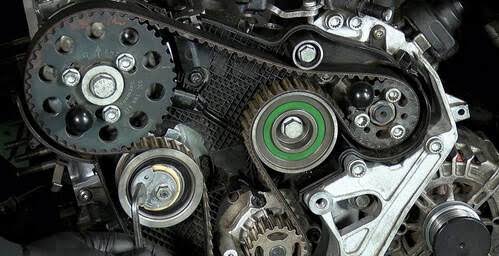
A cam belt kit includes tensioners, idler pulleys and, on many engines, the water pump. All these components share the same service life. A seized idler or a fatigued tensioner can destroy a new belt in minutes. On VAG, PSA Group and Ford engines where the water pump is driven by the belt, a failing pump bearing strips teeth instantly. We always fit a complete kit with a new pump and stretch bolts as standard. Saving a few pounds by omitting these parts is false economy that risks the entire engine.
What a UK-Spec Cam Belt Service Should Cost You
UK main dealer labour rates range from £120–200 per hour in the South East to £90–130 further north; independent specialists charge £55–85. A typical cam belt replacement takes 3–5 hours. Using a Ford Focus 1.0 EcoBoost as an example, a main dealer quotes £950–£1,200, while a quality independent using OEM-grade Gates or INA kits charges £650–£850. Always ask whether the price includes the full kit, water pump, coolant and VAT—too-good-to-be-true headline figures usually exclude tensioners and pump, pushing the final bill much higher.
Frequently Asked Questions
What happens if my cam belt snaps while driving?
In an interference engine, the pistons will collide with the valves, bending them and potentially damaging the cylinder head, pistons and connecting rods. The engine will stop immediately and the repair bill typically starts at £1,500 and can exceed £4,000. In many cases, the car is written off economically. Even on a non-interference engine, you will be stranded and require recovery.
Can I check the condition of my cam belt myself?
You can perform a basic visual inspection if you have access to the belt cover, looking for cracking, fraying, glazing or missing teeth on the visible section. However, internal degradation, tensioner wear and oil contamination are invisible without partial disassembly. A visual check is not a substitute for adhering to the manufacturer interval.
Does a cam belt replacement include the water pump?
It should, but not all garages quote it as standard. On engines where the water pump is driven by the cam belt—including most VAG, Ford and PSA Group units—replacing the pump simultaneously is essential. Always confirm the water pump is included in your quote before booking.
Is a timing chain really maintenance-free?
No. While timing chains are designed to last the life of the engine, tensioners, guides and the chain itself can wear, especially if oil changes are neglected. Many manufacturers have issued technical bulletins for premature chain wear. Listen for a rattling noise on cold start and address it immediately to avoid engine failure.
How do I find my car’s exact cam belt interval?
Check your vehicle’s service book or owner’s manual first. If unavailable, contact a main dealer with your registration or VIN—they can look up the factory schedule for your specific engine code. Online forums often quote generic intervals that may not apply to your exact variant, so always verify with an official source.
Proactive replacement based on your manufacturer’s time clause is always cheaper than a reactive engine repair. Take five minutes tonight to find your handbook and check your interval. If you’re overdue, call a specialist who uses complete kits and transparent pricing. Your engine—and your wallet—will thank you.